Mathew Kaminski, a former employee of CPP Investments, wrote a lengthy blog comment on how CPP executives are manipulating their benchmarks to pay themselves before your retirement.
He calls it an insider's perspective
on the illegitimate $100 million dollar wealth transfer from Canadian taxpayers to CPP execs and employees, and exactly how they covered it
up:
As you may have seen, CPP Investments published its Annual Report for the Year Ending March 2026 yesterday.
It
would be one thing if CPP was underperforming their benchmark. It would
be another if they were manipulating their benchmark to pay themselves
unduly. It would be another if they were depressing growth in the
Canadian economy writ-large to cover it all up. I’ll prove they are
doing all three.
In short, CPP Investments leadership manipulated their benchmarks
over 2025 and 2026 to pay themselves and their teams at least an extra
$100 million while they missed the baseline target of 4% real return
needed to sustain the CPP in the long-term.
Along the way,
I’ll reference prior annual reports and my own first-hand knowledge as a
former employee to provide you, a government-mandated CPP contributor,
with a clear story. A story of how a couple key decisions resulted in
the CPP contributing an immense amount of value to
Canadian pensioners prior to 2015, and then how its organizational ego
got overblown… eventually leading to leadership in 2025 introducing an
ill-defined slush fund called the Annual Strategic
Objectives Performance Multiplier (henceforth, the “Slush Multiplier”,
because I never want you to have to read Annual Strategic Objectives Performance Multiplier again!).
The
Slush Multiplier has allowed CPP leaders to increase their compensation
and that of their employees in a way that (i) they do not attempt to
justify in their annual reporting, and (ii) has no basis in whether
they’ve achieved the minimum return hurdle needed to sustain the fund.
The introduction of the Slush Multiplier alone helped
CPP employees earn over $100 million in undue compensation over the
last two years while CPP missed its baseline real return target.
It’s
also a story of how CPP leadership in 2025 manipulated the benchmark
used by the Federal government (and thereby you) to assess their
performance, clouding it in investment jargon so that they can unjustly
pocket additional hundreds of millions of dollars of compensation while underperforming their prior standard by hundreds of billions.
I’ll
also explain how the funding gap these items created was covered up, in
large part, by raising contribution rates on CPP to the tune of tens of
billions of dollars each year, directly depressing growth in the
Canadian economy.
Finally, I’m going to tell you how it can be
fixed, despite CPP Investment’s government monopoly on the pensions of
20-million-plus Canadians.
You may find the
explanation for all of this boring, and you’d probably be right, which
is why it’s so sinister. I’ve attempted to enliven it. The difference
between you receiving what you’ve paid into CPP when you turn 65, or
receiving a fraction of what you’re owed today, is reading this and
speaking up.
WHAT HAPPENED IN THIS YEAR’S REPORT?
CPP
Investments reported an annual return of 7.8% for the year ended March
31 2026. This underperformed CPP’s benchmark return of 13.2% by -5.4%.
On assets of ~$700 billion, that reflects $38 billion of ‘forgone’ value
last year alone, or roughly $1,000 for every Canadian. Not great, right? But they still grew the fund, you might say! I agree, hold on.
Let’s
leave alone that the S&P500 and MSCI World both returned at least
15% over the same timeframe, with the Nasdaq and TSX60 exceeding 25%. But it’s only one year and CPP is a long-term investor, right? I must, again, agree, but tell you I can explain.
Before
we start breaking down the fund’s returns over a longer five-year
period - the timeframe CPP uses to evaluate itself for compensation
purposes - let’s ground ourselves in what the fund paid to its average
employee last year.
In 2026, CPP had $2.3-$2.5 billion in
non-interest expenses, depending on how you define it, around $1.2
billion of which went to its 2,000+ employees. In totality, CPP salaries
were ~0.2% of AUM, versus most large ETFs at <0.1% for total fees.
This equates to roughly $500,000 per employee, on average. Now, in years
with great performance, you could say CPP employees deserve a huge payday, right? After all, they’d be delivering billions in value to the 20-million-plus Canadians who contribute to the program with every paycheck… right? Again, I agree… assuming they performed.
But,
did CPP Investments’ performance over the last five years deserve $1.2
billion in compensation in 2026? Short answer, no. Long answer, buckle
up…
COMPENSATION BREAKDOWN
To
proceed, we must define specifically how the average CPP investment
professional makes their annual half-million. In short, they get a base
salary and also a bonus target of between 20-70% of total comp. For a
$500,000 take-home, let’s say $200,000 is the salary and $300,000 is the
“Bonus Target”. On its own, as finance jobs go, that’s not abjectly
absurd. You want to hire good people and pay them handsomely in a way
that’s based on performance. There are very few people in the world who
can genuinely earn above-average returns on a portfolio year-in and
year-out, and when they do it in private industry they get rich. Warren
Buffett rich. So to get them to come to your pension fund, you want
to pay them very well when they perform. You want to make them not
quite as rich as those in private industry, but rich and powerful enough
to belong to the same clubs and associations.
Prior to 2025, the bonus target of CPP employees was based purely on performance - one
half absolute (e.g., a 7% return) and one half relative (e.g., 7%
actual return beat the benchmark of 6% by 1 percentage point). Now,
this may not sound problematic theoretically, but if you open the 2024
annual report and go to page 74… you’ll see this became a massive problem for CPP leaders. This Pure Performance Multiplier algorithm spat out a multiplier of 0.62x for the year ending March 2024. Ouch!
This is actually a massive problem, not for taxpayers - I mean, yes for
taxpayers - but more immediately for CPP leadership and their ability
to manage their employees.
Since the performance
multiple was 0.62x, an employee making ~$500,000 would receive $186,000
as a bonus instead of his normal $300,000. Even after-tax at the highest
marginal rate that difference is at least a year, maybe even two, at
Upper Canada College! They might have to go to… shivers… public school! Won’t somebody PLEASE think of the children?!
On
one hand, I can empathize with someone thinking they’re going to get
$300,000 and getting $186,000 instead. If I employed that person I’d be
concerned about being able to continue to manage them. Maybe they’d find
a new job. I get that.
With my other, CPP-contributing hand, I’m pulling a Mr. Krabs.
Anyway,
CPP leaders saw the incentive problem this created with their
employees, and so they resolved to change the compensation structure in
2025. But how? Maybe they could reduce the lookback? Or change how comp was tied to performance? Let’s look at what they actually did.
THE SLUSH MULTIPLIER
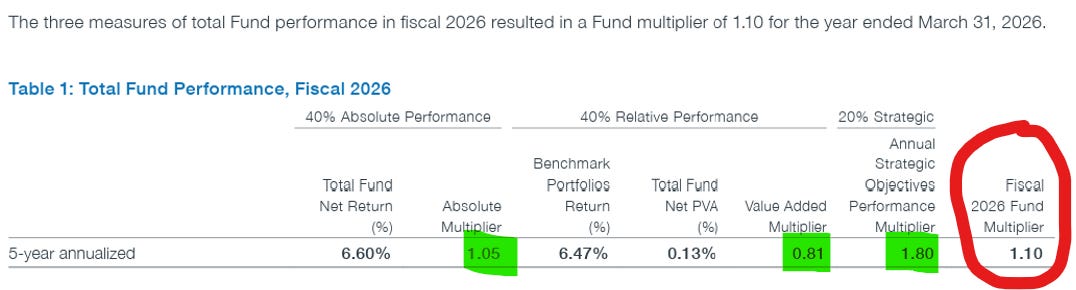
CPP Investments helpfully breaks down their Fund Multiplier calculation for 2026, which spits out 1.10x (ahhh, SO much better than 0.62x!). This is pictured below and can be found on page 82 of the report:
But how did they get from a 0.62x to a 1.10x Fund Multiple in two years? Let me break it down:
40% of the multiplier is now based on Absolute Performance, versus 50% in 2024. On its own, not entirely absurd.
However,
CPP employees “earned” a 1.05x multiplier in 2026 for achieving a 6.6%
return over the last five years, including inflation, which is actually a
pretty huge problem, arguably more so than anything else I’ll speak to
in this entire article.
According to the 2026 Annual Report, the
chief actuary of Canada says that the organization must earn an average
annual return of 4.0% after inflation to be sustainable, long-term. Inflation in Canada over the last five years was 3.7%, meaning the real
post-inflation return of the Base CPP has been 2.9% over the last five
years, missing its long-term Chief Actuary target by MORE than a full
percentage point. The leaders of the CPP confirm this on
page 37 of the 2026 annual report, but inexplicably still give
themselves a 1.05 multiplier here.
Moving on for now…
40% is Relative Performance versus 50% before, which still feels mostly appropriate. This earned employees a 0.81x multiplier on their bonuses for being… 0.13% above their Benchmark.
This
actually felt kind of punitive to me, and offsets the generous Absolute
Performance multiple a bit, so at the risk of over-explaining
everything, let me just say, for now, “I’d be OK with this in
isolation”. However, it does make me think… why such a low multiple for outperforming your Benchmark?
Combined, this 80% spits out a multiplier of 0.93x. Definitely better than 0.64x, but still not quite 1.10x…
The
final 20% of the 2026 compensation algorithm is our Slush Multiplier,
established 2025, which is 1.80x. Which… well… like… OK… I guess!
Theoretically, it could make sense! It really depends on if there are
valuable objectives that the CPP leaders are executing on super well. To give yourself a healthy 1.8x multiplier they must have done a really good job at all the other important objectives they had besides
generating returns for pensioners? Maybe they solved world hunger, or
unblocked the Strait of Hormuz? Let’s take a look at those all-important
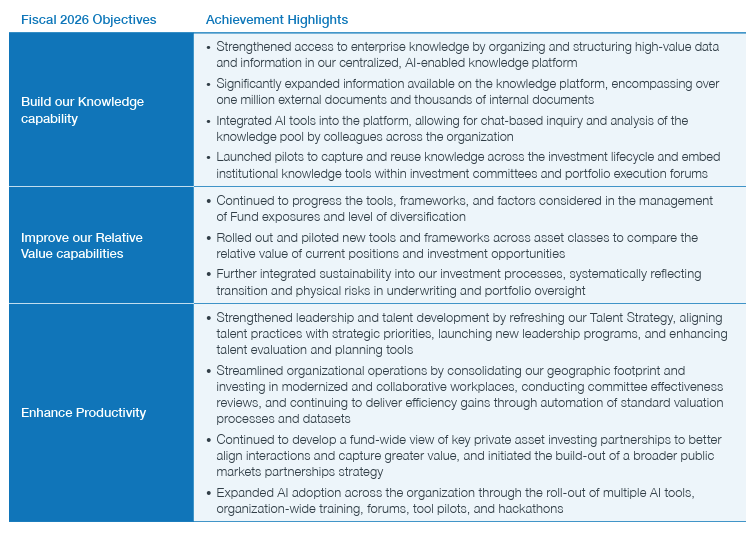
strategic objectives:
I
mean…I don’t know if that means anything to you but it doesn’t to me! I
hope McKinsey was well-paid for that pablum. I want to emphasize that
the overall Fund Multiple moved from ~0.9x to 1.1x because of just how well everyone at CPP executed on… checks notes…
“refreshing our Talent Strategy”, “piloting new tools and frameworks
across asset classes to compare relative value of current positions and
investment opportunities”, “Expanding information available on the
knowledge platform by one million external documents”, and “Continuing
to progress the tools frameworks and factors considered in the
management of Fund exposures and level of diversification”. Deep breath.
That
move that the Slush Multiplier creates - from 0.93x to 1.10x -
represents a transfer from the Canadian taxpayers to CPP Employees to
the tune of $50-100 million last year alone, and even more in 2025 when
the Slush Multiplier was a whopping 2.0x.
John
Graham, President & CEO of CPP Investments, earned ~$7 million on a
1.33x performance bonus (better than the rest of his employees) while
underperforming his benchmark. The Board of Directors actually does at
least attempt to justify the G-man’s compensation on page 80 of the 2026
report [my emphasis added].
“Our assessment of Mr.
Graham for the year reflects several significant achievements, including
strong financial performance despite a challenging global environment
[STOCK INDEXES WERE UP 15-25%, BUT I GUESS TRUMP WAS A REAL JERK?!]. By
also advancing key strategic objectives, Mr. Graham ensured CPP
Investments maintained its focus on long-term value during the year
[HOW, EXACTLY?!]. The Board awarded him an incentive multiplier of 1.55
[BASED ON WHAT?!]. The weighted average of the Fund multiplier and the
department/ individual multiplier resulted in an overall incentive
multiplier for Mr. Graham of 1.33 . The Board awarded Mr. Graham total
direct compensation of $6,827,644 for fiscal 2026, consisting of salary,
an in-year award and deferred awards, as shown in Table 2. Mr. Graham
also received standard pension and benefits. [MUST BE NICE!!]”
So, in 2026, the CEO and employees of CPP Investments were judged to have earned their full target bonus and an extra 10% of juice on their bonuses because they did such a good job achieving their vague strategic objectives while underperforming
the 4% real rate of return required to keep the CPP in good standing
over a generous investment period of five years. Furthermore,
the CEO responsible for all this gets an EVEN HIGHER multiplier of
1.55x on his individual performance to get him a $7 million payday.
So, I mean… that’s bad on its own. But that’s it, right?
CPP’s leaders solved their employee retention problem with the Slush
Multiplier, and we’re just losing a couple hundred million bucks to
their North York extensions? Trickle-down economics, right? It’s still good! It’s still good!
Laughs in Orwellian.
Just wait… it gets worse…
A HISTORY LESSON
I
got a funny feeling reading the 2026 report, that - regardless of the
new, wonky Slush Multiplier - the actual benchmark numbers didn’t quite
make sense. Indeed, it seems that CPP Investments retroactively changed
how it calculates its benchmark portfolio as of the 2025 Fiscal Year.
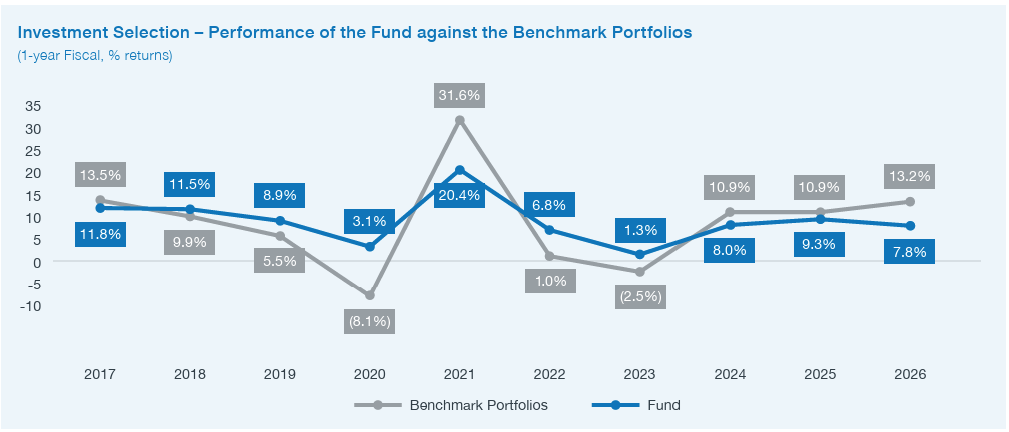
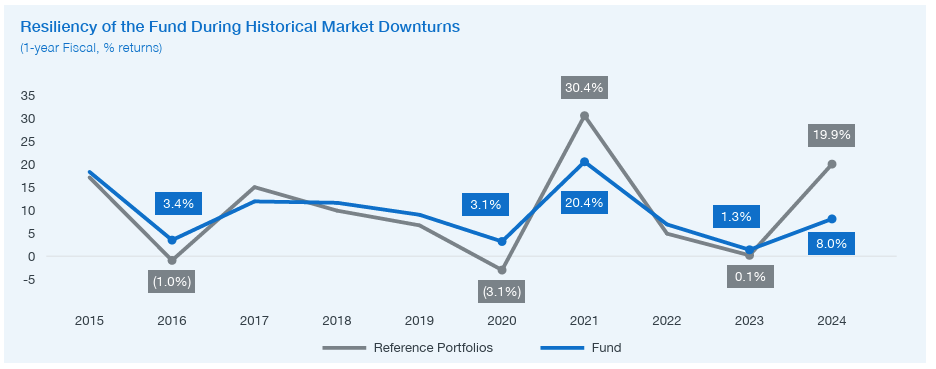
Review CPP’s 10-year historical returns versus benchmark for 2026 versus
2024 below, and you’ll see that - on the whole - the 2026 Benchmark is
substantially easier than the one from 2024.
2026
2024
Before
I get into the why, I unfortunately need to take you through the entire
history of the organization. It’ll be… relatively quick.
In
2000, CPP Investments was just CPP, and it was managed more like a life
insurance portfolio before the Bill Gross era, invested in something
like 95% Debt and 5% Equity and employing a few traders to occasionally
re-balance the portfolio and stress test it against future cash
outflows. Thank goodness this was changed!
Our former Prime Minister Paul Martin, the late John MacNaughton and
the early teams at CPP deserve all the credit in the world for moving
toward a market risk target of 65% equity and 35% debt by 2007.
Regardless of the impending 2008 Great Financial Crisis right around the
corner, this investment mix decision undoubtedly generated hundreds of
billions for Canadian pensioners. Thousands for each and every Canadian.
That
said, the 2026 report goes on to say “a targeted risk level of 65% of
equity and 35% debt… is in the typical range for conventional fully
funded pension plans”. So while this was a great decision, I’d argue CPP
Investments simply did the bare minimum here, going from a
far-too-conservative position of 5/95 to a more-generally-held-standard
of 65/35. It would have been tantamount to malpractice NOT to move to
this number, especially with the organization’s unique position of still having decades until it was a net payor of cash.
In
2015, CPP Leadership went further. The Board of Directors approved an
increase in market risk from 65% equity / 35% debt to 85% equity / 15%
debt, to be phased in over a couple years. CPP Investments also adopted a
Benchmark Portfolio against which they’d compare their performance,
with 15% weighted toward Canadian government bonds and the other 85%
directly tied the “S&P Global LargeMidCap Index”, which is defined
as comprising “the stocks representing the top 85% of float-adjusted
market cap in each developed and emerging country.”
Another good decision! And
this time I’ll say that it wasn’t an obvious one. Many other pension
funds across the world held closer to the 65/35 standard, with many
still below that equity number today. However, there’s a good reason for
that, which is most other pension funds didn’t have the enviable
position of being a young fund and projected net receiver of cash for
another few decades. CPP Investments takes in funds from its CPP payroll
taxes which it uses to invest and will eventually use to pay retirement
benefits. US Social Security, Ontario Teachers, OMERS, the Japanese
Pension fund, and CalPERS, are all net payers of cash, relying on their
investment returns to fund immediate payments. If you look at CPP
Investment’s relative returns and compare them to other pension funds
across the world, CPP has routinely outperformed, but it does
so because of the structural advantage of being able to move to an
85/15 equity/debt split as a result of being a net receiver of cash
rather than net payer. The leadership at the time, led by Mark Wiseman,
current ambassador to the US and former Blackrock philanderer, was smart
not to ignore this.
From this point forward,
government bonds returned somewhere in the 1-2% range while S&P
Global LargeMidCap Index returned in excess of 13%, compounded annually, dividends reinvested.
The decision to go from 65/35 to 85/15 generated additional hundreds of
billions for Canadian taxpayers and should also be applauded.
I
still remember in 2014, diploma from Queen’s still available for
download from the student portal, when Mark greeted me and 30 or 40
other smart young minds who were joining CPP Investments for the first time.
See,
I fell into finance because I was smart, and I thought it was more
interesting than being an accountant. I ended up joining the firm
because my alternative was being an investment banking analyst - which
sucked and continues to suck - and back in those days Private Equity
funds hadn’t started reaching out with 24-hour exploding contracts in
the six figures to burgeoning senior kindergarteners with
99th-percentile paper-cutting skills. Basically, there are two broad
categories of Finance Jobs: sell-side, which is investment banking
(again, sucks) or equity research; and buy-side, which basically
involves working for “A Couple Rich Investor Dudes”, either at a private
equity fund or a public company.
I liked that I was venturing out
into the real world with the mission of earning money for hard-working
Canadians who trusted this money to be there for them. Better them than
ACRID.
And so, I sat in a meeting room on the 19th floor of
Two Queen West. It was in the kind of meeting room that has siblings in
virtually every other towering office building in the downtown Toronto
core dated to roughly my birthyear. Large banquet halls in the sky
with floor-to-popcorn-ceiling windows offering glimpses of Lake Ontario
between the other skyscrapers, each probably containing similar rooms
though their windows were tinted so I couldn’t be too sure. The room
could be divided by these giant movable accordion partitions covered in
the same soft fabric as the floor, presumably for acoustics. They had
been extended so that the room was divided into the correct amount of
space for the number of us in attendance.
Mark started by
reminding us that accepting gifts over $100 was reason for a written
warning or even an immediate termination without cause, and talked about
the opportunity we had to make life better for Canadian taxpayers and
the trust that they were placing in us. The second statement justified
the first, and we would take it to heart for a while as we watched all
our ACRID-backed friends get taken out to Leafs games. I was a Sens fan
anyway, I told myself.
Mark told us that the penalty for breaching
Canadians’ trust, collectively as an organization, was that we would be
replaced with three guys in a windowless basement rebalancing the 85/15
index. At the time, to a type-A kid just out of school with something
to prove, I took that as a threat. A threat that I didn’t have anything
to offer, to the profession or to the Canadian taxpayer. That my four
years at one of the finest business schools in Canada had been a waste.
It was intended as such, and it was the right threat for him to make.
Then,
Mark broke out a chart in which he showed that if CPP Investments
continued at its 65%-equity/35%-debt split, we could maybe earn a
3.5-4.0% real rate of return. However, if we took on more risk as a
maturing organization, by moving to 85/15, we could earn a 4.0-4.5% real
rate of return and be able to reduce contributions in the future.
Indeed, the 2019 annual report makes reference to this:
When
assessing the sustainability of the CPP, the Chief Actuary assumes a
long-term net annual return averaging 3.9% after inflation. If through
active management, we could consistently deliver returns averaging 0.5% a
year higher, then:
The minimum contribution rate could eventually be reduced from 9.79% of covered earnings to 9.43%.
That
is equivalent to a combined savings to employees and employers of more
than $1.7 billion annually at current earnings levels.
Alternatively,
the additional returns could be used to increase benefits or held in
reserve to strengthen the sustainability of the CPP.
But
wait, you’ll ask, isn’t the current contribution rate 11.9%, a full 2+
percentage points higher than the 9.79% they reference? And don’t I also
have to contribute 8% if I earn more than $75,000 when I didn’t have to
before 2019? The answer to both of those questions, simply, is yes.
Later that same year, CPP rates would be increased, the name changed to
CPP1 or Base CPP, and CPP2 or Additional CPP was introduced on incomes
above ~$75,000.
The stated reason was to bolster Canadian
retirement incomes: 25% of average income was insufficient to provide
for the average Canadian in retirement. I can’t say I whole-heartedly
disagree with that statement, but who made that decision and why?
Especially when earlier that same year CPP was talking about reducing
CPP contributions for the benefit of the Canadian economy, which was
never discussed again.
I’ve been told from sources that - if you
speak to anyone senior in the organization in 2019 who actually knew
what was going on - CPP Investments had accidentally over-extended
itself around this time. It had made too many non-cash-flowing and
illiquid investments and would either have to sell equities or raise
more cash in order to pay its near-term cash outflows. Now, none of this
was going to have to happen immediately, but the Chief Actuary would
have had to talk about the impact in their next report, and selling
equities would have “piled on” to the issues within said report. To
explain that in slightly more detail, when you remove equities from the
portfolio to pay for immediate liquidity needs, that creates a much
larger gap in 20-30 years because you’ve lost an asset that would have
returned 8-12% over the next 20-30 years. You and I don’t see this
clearly in the reporting but the Chief Actuary would have.
There
was an exodus of senior leaders during this time, which you can track,
and if you ask the junior folks, the fund stopped doing deals for a
while in many of its groups. Of course, it couldn’t stop entirely or it
would be too obvious. The answer was to do fewer deals while tapping the
Canadian tax payer for incremental CPP1 contributions AND incremental
CPP2 contributions.
The cost of that answer, based on extrapolating the never-realized savings from the 2019 Report, would tell us that CPP
has increased its drain on the Canadian taxpayer (split between
employer and employee EVENLY) by $10 billion annually since that time.
That’s $125 out of the pocket of the average Canadian, every year, and
$125 out of the pocket of every employer for each full-time worker in
its employ.
The CPP’s historical journey from 2000 to
2015 to move from a 5/95 portfolio to an 85/15 portfolio was very
positive. We, as Canadians, can rightly be proud of the CPP and its
leaders during this time, and of the decision-making that led the
organization there. But that all happened over a decade ago. I’m not
here to argue the history or whether CPP Investments has contributed
positively to Canadians as a whole. It undoubtedly has.
I’m asking… WTF has been happening in the last few years?!
INTO THE WILDERNESS
From 2015 to 2025, CPP Investments used a benchmark of 85% S&P Global LargeMidCap Index
to reflect the equity part of its returns and 15% in a Canadian
Government Bond Index to reflect the debt part. To me, this makes a lot
of sense. Easy and simple to understand, this benchmark also has the
benefit of fairly accurately reflecting the types of assets the fund
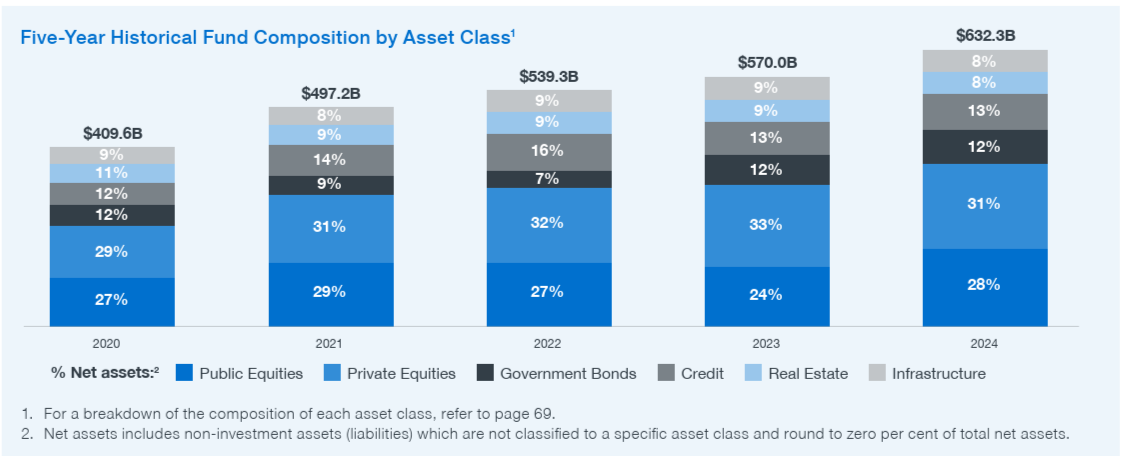
held, as you can see in the chart below. This is especially the case if
you assume that Infrastructure, High-Yield Credit, and Real Estate are
more reflective of equity returns over time than debt. I think there’s
some nuances there I can’t get into here, but overall I’d agree with
that assessment. If you argued for a more lenient 80/20 or 75/25
benchmark rather than an 85/15 based on this fact, you could convince
me. I’d get on board. Overall, that would feel right to me!
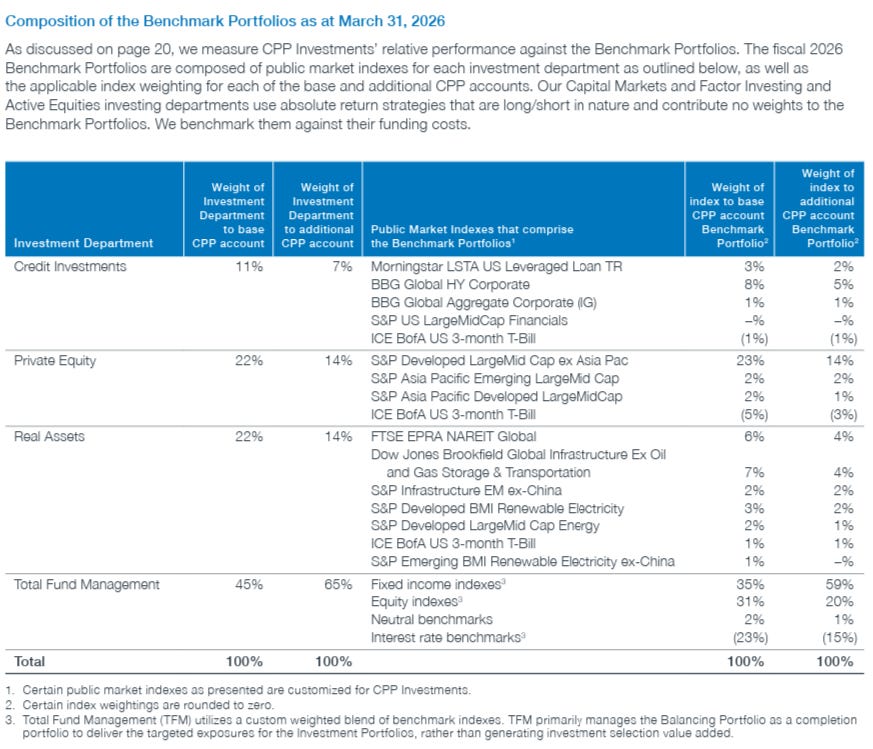
So what did CPP Investments change their Benchmark to in 2025? Let’s take a look!
I
mean… I don’t know what to do with that. I’m a CFA and an investment
professional who should be able to interpret this, and I have NO
FREAKING CLUE what to do with that.
What I can tell you -
and this is the upshot - is that based on CPP Investment reporting, the
“revamped” 2026 Benchmark Portfolio returned 8.1% over the last five
years.
The Benchmark Portfolio CPP Investments would have
had to use if they hadn’t changed it in 2025? That lovely… simple…
beautiful… 85/15 index that I used to know like Gotye… returned 11.6% annually over the same five years. I don’t know what that 40% Relative Performance multiplier would be for underperforming that index but I bet it’s a lot lower than the 0.81x that got used for 2026.
Let’s
reframe those numbers another way though. CPP Investments had ~$400
billion in assets in March 2019, so if they had simply invested 85% in
their equity benchmark (”S&P Global LargeMidCap Index” yielding
13.3%) and 15% in Canadian Government Bonds yielding a conservative 1%
over the last five years… CPP Investments would have an incremental $140
billion in returns over those five years versus what they actually
earned, with no incremental CPP1 or CPP2 contributions required. That’s
an extra $3,500 in each Canadian’s pocket.
To put that yet
another way, if CPP Investments had actually invested 58% of its funds
into the LargeMidCap Index at 13.3%, and the other 42% in Canadian Bonds
at 1%, it would have done just as well as the 2,000+ employees at CPP
Investments actually did. Read that again.
For the
inclined among you, I asked ChatGPT and Gemini… and they both said if
your active manager can’t beat a 75/25 index, you should get rid of them
and invest passively! That matches my gut. CPP Investments is at 58/42.
CPP
Investments gave themselves the Slush Multiplier to try to pay
themselves more, but it wasn’t enough, so they had to adjust their
relative benchmark too.
SO WHAT DO WE DO?
Well,
first, you can get upset. No, but really. Share this and maybe it’ll
get around. Send it to your representatives. The Globe and Toronto Star
both had articles on this yesterday with broadly similar takeaways, but
their articles are behind paywalls and don’t have the whole context. To
change the charter of CPP Investments requires a 2/3rds vote of the
Canadian senate representing 2/3rds of Canadian provinces. It’s very
hard to do! The only way for it to change is general public outcry.
I know how CPP Investments works. There are hundreds of people there (maybe dozens)
who are concerned about the future of the average Canadian’s retirement
in the same way I am; they are people still not accepting that $100+
gift from a client because they want your trust. There are hundreds more
just keeping their heads down and pretending - to others and themselves
- not to hear the loud sucking sound their employer is making at the
roots of the Canadian economy. These people are - mostly, like any group
of people - good at their core. I’ve enjoyed a beer or two with many of
them. However, the only way to effect change is for the 20-million-plus
Canadians who contribute to the fund, as well as those inside it, to
demand transparency and accountability. For our benefit, our children’s
benefit, and for the employees, because living in the Orwellian
nightmare of CPP Investments is not healthy for them either. But hey,
that’s just, like, my opinion, man.
You can share this and
we can collectively demand that the CPP leaders do some combination of:
(i) become more transparent rather than less, and (ii) shift to a
less-expensive form of asset management largely focused on passive index
investing... over time. I’m not saying they have to do it tomorrow, as
that also involves risk. There are also a variety of ways to accomplish
it. We could cap CPP Investment’s expense ratios below current levels in
a graduated manner to “force” a move toward passive indexing in a
similar way to how one might dollar-cost-average into the market. We
could also demand more clarity on compensation calculations, like the
1.8x Slush Multiplier and the 1.55x individual performance multiplier
While
I find CPP’s performance lacking versus the market, that’s actually not
my chief issue with the report. If they were honest about their
performance and didn’t introduce the Slush Multiplier, I wouldn’t have
been able to write this article. The reality is that CPP Investments’
leaders adjusted their benchmarks and introduced a Slush Multiplier to
increase their own compensation and make it easier for themselves to
manage employee turnover, while failing to meet the minimum real return
of 4% required by the Chief Actuary over a significant period of five
years. In doing so, they put themselves before your retirement.
If
CPP’s leaders really cared about their professed purpose at the top of
the 2026 Annual Report to “help provide a foundation for more than 22
million Canadians to help build their financial security in retirement” -
tough tagline by the way, use a thesaurus -
they’d be honest in their reporting and we could have a real
conversation about them reducing their active management of investments,
over time. They can’t beat the index, and Canadians shouldn’t give them
more time to try.
Looking forward to any feedback and
answering any questions. If you’d like to understand but don’t, shoot me
a message… I probably just explained that part poorly.
EDIT:
I
have to come clean, I wish I’d included this in my original piece... I
would like to say that this all comes from a place of love, for the
taxpayer and the employee at CPPIB. I don’t think they should all lose
their jobs nor a majority of them nor should we move to a passive index
tomorrow. What’s life without a little mystery, though?
Alright, a lot of people have brought this to my attention, I saw it posted on LinkedIn. I even had an exchange with Mark Kaminski (publicly, not privately) via his comments section.
I read his long comment, at times he brings up good points on transparency, other times, I cringed, reminded me a bit of when I used to write my blog angry and just blurt things down.
I think it's fair to say, his comment needs to be tightened up considerably; there are passages that quite frankly aren't very professional.
But leaving that aside, I wanted to address his main concern, namely, that CPP Investments is gaming its benchmarks to dole out multimillion-dollar compensation packages to senior execs.
Those are serious accusations, especially coming from a former employee.
And to be sure, I've seen my share of gaming benchmarks at PSP during my time there which is what got me started on my blogging escapades almost 20 years ago.
For example, I was at a board meeting at PSP where two board members asked me straight out if the risks the real estate department was taking were reflected in their benchmark.
I looked at my CEO and he told me to answer the question so I did: "Well, no, their benchmark is CPI + 500 basis points and they're taking all sorts of risks in opportunistic real estate to garner 20%+ in returns annually."
That didn't go well with senior execs, along with all my other warnings about stupid credit risks PSP was taking at the time (selling CDS, buying ABCP), it ended costing me my job (my underlying health condition, however, was the real reason I was fired but alas, I couldn't hide the fact I had MS and knew for months I was a sitting duck).
So, when I hear people say "just ignore him, he is a disgruntled former employee," I say wait up, don't be too quick to judge former employees.
Now, I did reach out to CPP Investments and shared Mark's comment with them and they were kind enough to respond today.
Michel Leduc, Senior Managing Director and Chief Public Affairs Officer, sent me this:
The allegations the individual is circulating don't hold up to the facts.
The writer treats a simple two-asset risk target as if it were the
prudent benchmark for a global pension fund investing across asset
classes, public
and private. It isn't. The letter alleges CPP Investments manipulated
benchmarks in 2025 and 2026 to pay executives more. The annual report
record, the disclosed compensation outcome, and the long-run expected
return of the Benchmark Portfolios all contradict
that claim.
CPP
Investments has disclosed for several years that the actual Fund was
not managed as an 85/15 global-equity/Canadian-bond
portfolio. The framework (Strategic Portfolios, Active and Balancing
Portfolios, leverage, factor exposures, strategy-level passive
comparators) was set out in the fiscal 2022 and 2023 Annual Reports.
Strategic Portfolios were approved in fiscal 2021 and ran
through fiscal 2024. Active selection was already being measured
against risk-comparable passive indexes well before the Benchmark
Portfolios were formalized. Fiscal 2024 went further still and disclosed
that a more representative benchmark was being developed
and explained why: the Fund had deliberately diversified beyond the two
asset classes of the Reference Portfolios, which had become an
increasingly poor relative-performance comparator. Fiscal 2025 then
formalized the change. The evolution did not appear out
of nowhere. Indeed, we find that the 85/15 risk target, if directly
invested in a typical global index (rather than serving as diversified
risk equivalency) would be reckless for a national pension fund given
concentration levels, which have intensified more
than 100% over the last decade. By that measure alone, the Reference
Portfolios provide a distorted comparable for performance metrics.
A
Market Risk Target answers one question: how much market risk should
the Fund take? A Benchmark Portfolio answers
a different one: did active and balancing strategies add value relative
to passive, investible alternatives for the strategies actually used?
The individual is misguided in seeking to collapse these into a single
question. They aren't the same.
The
claim that the new benchmarks were designed to lower the bar fails on
the disclosure itself. The Benchmark Portfolios
have slightly higher long-run expected absolute returns than the Market
Risk Targets, because diversification compounds. Over the appropriate
horizon, which amounts to decades, not quarters, the new benchmark is a
higher more difficult hurdle, not a lower
one. The argument against it depends on a recent stretch in which
concentrated U.S. mega-cap technology and communications names dominate
public-market returns. That's not a long-horizon pension argument. It's
market timing plain and simple.
It's
also a textbook case of recency bias, which is well-documented. Because
a narrow sector has recently outperformed,
the argument retroactively concludes a prudent fiduciary should have
concentrated there, and treats diversification as failure. Kahneman,
Tversky, and Shiller all documented exactly this pattern. Morningstar
has warned investors enamoured of recent winners
against it. Our framework is built to resist that temptation: it
doesn't chase yesterday's winners and doesn't confuse concentration with
prudence because concentration happens to be rewarded today.
Concentrators may be winning at the moment. That isn't a
strategy for a national pension fund.
The
compensation allegation is contradicted by the math. In fiscal 2025,
the five-year annualized return of the
Benchmark Portfolios was 9.73% against the Fund's 8.98%. Net relative
performance was negative 0.75%. The Value Added Multiplier came in at
0.17. A 0.17x multiplier is not a manufactured windfall. It's a sharply
reduced score under the disclosed formula. Any
claim that the new benchmarks were adopted to engineer a pay benefit
has to ignore that the relative result was negative. Importantly, as
clearly described in our annual reports, the compensation framework is
about appropriate incentives holistically to align
the work of investors with enduring value for the CPP, and not simply
benchmarking. A reminder that the pension promise depends on strong
absolute returns, which is precisely why the Fund is so far ahead of
projections, enabling Canada's finance ministers
to cut the contribution rate by 40bps thus putting billions of dollars
back into the Canadian economy. We are not aware of any similar
circumstances occurring anywhere else, globally. Worth noting the CPP
Fund ranks second in terms of ten-year financial performance
among the top 25 global public pension funds. Let's get back to what
really matters and not lose the plot in the weeds.
The
CFA/GIPS guidance expressly recognizes that a retroactive change may be
appropriate where the new benchmark
is a better comparison for the investment strategy. It warns against
changes designed to flatter performance. That isn't what happened here.
The change was disclosed, the rationale was explained, the construction
was described, the Market Risk Targets remain
in place as a risk gauge, and the disclosed five-year
relative-performance outcome was negative.
The
market-concentration dynamic isn't theoretical. Fiscal 2026 reported
the Fund at 7.8% against a benchmark of
13.2%, with the benchmark boosted by heavier exposure to large
technology companies that outpaced the broader market. Fiscal 2024 had
already warned that this environment could make a diversified portfolio
look worse against a public-equity-heavy comparator,
even when diversification remained prudent. The warning preceded the
outcome.
The
accurate account is straightforward. CPP Investments evolved its
performance-measurement framework over multiple
years as the Fund became more diversified, as public markets became
more concentrated, and as the former Reference Portfolios became
increasingly disconnected from the actual Investment Portfolios. Fiscal
2025 formalized that evolution. It didn't create it.
A story that presents this as retroactive benchmark manipulation to
boost pay leaves readers with a materially false impression of the
public record. For clarity, here is a summary of the facts:
1. Annual report disclosure trail is extensive.
The fiscal 2022 Annual Report described strategy, performance,
governance, investment approach, risk management, cost management and
pay-for-performance, with performance attribution over the fiscal year
and over five years.
2. The framework predates fiscal 2025.
The fiscal 2023 Annual Report states that Strategic Portfolios were
approved in fiscal 2021 to be effective from fiscal 2022 through fiscal
2024. Those Strategic Portfolios were diversified across public equity,
private equity, public fixed income, credit,
real assets, cash/absolute-return strategies and geographies.
3. The actual Fund was not “the Reference Portfolio.”
The fiscal 2023 Annual Report states that Investment Portfolios were
exposed to Active and Balancing Portfolios; the Balancing Portfolio
completed and rebalanced targeted exposures; and the Active and
Balancing Portfolios together delivered targeted factor
exposures at targeted risk while diversifying asset class, geography,
currency and sector exposures.
4. Strategy-level passive comparators existed before the Benchmark Portfolios were formalized.
The fiscal 2023 Annual Report states that active investment selection
was measured against risk-comparable passive public-market indexes to
objectively assess each active strategy’s contribution.
5. Fiscal 2024 expressly warned about the concentration issue.
The report explained that diversified portfolios can trail concentrated
global public-equity portfolios when global public equities materially
outperform, especially when performance is driven by a small number of
very large companies concentrated in one sector
or geography.
6. Fiscal 2024 expressly foreshadowed the benchmark transition.
CPP Investments disclosed that it was developing a performance benchmark
more representative of how it assessed the effectiveness of its
investment strategies.
7. Fiscal 2025 separated risk targets from performance benchmarks.
The fiscal 2025 Annual Report states that Market Risk Targets,
previously Reference Portfolios, express targeted market risk, while
Benchmark Portfolios replaced them as the benchmark for relative
performance.
8. The reason for the change was disclosed.
The fiscal 2025 Annual Report states that since fiscal 2016 the Fund had
become more diversified, the role of the Market Risk Targets shifted
primarily to representing targeted market risk, and the Market Risk
Targets became increasingly disconnected from the
targeted exposures of the Investment Portfolios.
9. The new benchmark is not an easier long-run hurdle.
CPP Investments disclosed that the Benchmark Portfolios have slightly
higher long-run expected absolute returns than the simple two-asset
Market Risk Targets and are more resilient to equity-market downturns.
10. The “retroactive” point is aligned with CFA/GIPS guidance.
The CFA/GIPS guidance says most benchmark changes should be prospective,
but it also states that retroactive changes may be appropriate where a
new benchmark is a better comparison for an investment strategy.
11. The compensation allegation fails on the disclosed math.
The fiscal 2025 compensation table shows a five-year annualized Fund net
return of 8.98%, Benchmark Portfolios return of 9.73%, negative net
relative performance of 0.75%, a Value Added Multiplier of 0.17 and a
Fund Multiplier of 1.04.
12. Governance is not self-directed in the casual sense alleged.
CPP Investments is governed by an independent Board, operates at arm’s
length from government, undergoes external audit, and is subject to a
special examination every six years; the most recent special examination
by Deloitte in 2022 gave a clean opinion with
no significant deficiencies in the systems and practices examined.
Alright, I thank Michel for sending me this, think he explains in detail how the changes in benchmarks were detailed in previous annual reports leading up to fiscal 2025 when they were adopted.
My only point of contention is the most recent special examination done by Deloitte, those are standard audits, not in-depth performance audits that kick the tires hard on benchmarks (good luck finding a firm that does this properly and independently).
Now, I have a recommendation to CPP Investments. On your website, you should have a detailed section on benchmarks, specifically the evolution of benchmarks in relation to the evolution of the active management strategy and portfolios. Michel goes over the main points above but a detailed discussion is worth it.
Quite honestly, every large pension fund I cover on my blog should do this; however, because CPP Investments is the biggest and most important one, and prides itself on transparency, I highly recommend it does this and even have a section in its annual report going over the evolution of benchmarks throughout time and why changes were made.
Now, I went over the Fiscal 2025 report here and can validate all the numbers Michel gave above:
What about fiscal 2026? Again, from the most recent report (pages 81-82):
As you can see, taking into account absolute and relative performance, the fiscal 2026 Fund Multiplier is 1.1, slightly above 1.04 of fiscal 2025.
Importantly, there is nothing out of the ordinary here, the explanation is given in the Compensation section and it's very clear.
I know, some critics think it should just be relative performance but by doing that, you force the Fund to chase returns in a very concentrated market, which they will not do (for reasons Michel outlines above).
Also, look at the fiscal 2026 press release and look at all the deals they entered.
Part of the compensation at any pension fund has to be on meeting strategic objectives, it can't all be based on absolute performance or relative performance.
By the way, on absolute performance, the Fund is doing very well over the last 10 years, it has more than enough assets to cover long-dated liabilities, so I don't understand the criticism.
In fact, they're lowering the contribution rate because performance has been very strong, which is a first in developed countries.
What about the famous 85/15 benchmark? No doubt, relative performance would have been worse in fiscal 2026 had they kept it but it doesn't properly reflect the risks of their underlying portfolio and over the long run the new benchmark has higher expected returns and less downside risk.
I always hated that 85/15 benchmark and told Mark Wiseman long ago when I met him that there will be a time when it "causes you nothing but headaches" and it doesn't properly reflect the true risks of the underlying portfolio which is more diversified across assets, sectors and geographies.
Again, a comprehensive performance audit of benchmarks (which the Auditor General should undertake along with the Bank of Canada) would have proven my point easily back then.
Alright, let me wrap this up because I can go on and on but there is no gaming of benchmarks at CPP Investments and I think the criticism is misplaced and just plain wrong in many areas.
Lastly, unlike Mark, I think contributions to CPP are good for the Canadian economy over the long run so I don't see contributions as a tax on our citizens.
I thank Mark for sharing a lot on his blog post and stimulating a discussion but just like Millennial Moron and Andrew Coyne, I don't agree with the criticism.
I have no issues with John Graham pulling in $7 million a year, or Charles Emond $5 million or Jo Taylor and Blake Hutcheson's compensation. Remember, all these CEOs have been with their organization for a long time and that too factors into the equation.
Are there compensation issues at these large funds? Does everyone
pulling in over a million dollars a year deserve it? I have my thoughts
on that too (hell no!) but that will be for another time.
Below, watch John Graham and others discuss fiscal 2026 results.
Make sure you read my recent discussion with John covering fiscal 2026 results here.



Comments
Post a Comment