Earlier this week, HOOPP issued a press release stating new research it commissioned finds pensions help retain experienced healthcare workers, while making the sector attractive to younger talent:
TORONTO, November 16, 2026 — New research from the Healthcare of Ontario Pension Plan (HOOPP) finds workforce stability is a significant priority for Canadian healthcare employers, with respondents focused on retaining experienced workers while also attracting new talent. The findings also highlight the role retirement benefits, particularly defined benefit pensions, can play in supporting those workforce objectives.
The 2026 Canadian Employer Pension Survey by HOOPP makes an explicit connection between retention and patient care: 97% of healthcare employers agree that retaining experienced healthcare workers helps maintain the quality and continuity of care. The survey also found one of the most important factors in retaining and attracting healthcare workers is to offer retirement benefits, and particularly a defined benefit (DB) pension plan. Almost all employers (94%) said helping employees retire when they are financially ready supports workforce renewal and succession planning.
“In healthcare, retaining and attracting staff is not just an HR challenge. Employers recognize the importance of workforce stability to continuity and quality of patient care,” said Jennifer Rook, HOOPP’s Vice President of Government, Regulatory and Stakeholder Affairs. “Retirement security can help support those workforce goals. The survey findings show that healthcare employers clearly see the value in DB pensions as a tool to retain experience, attract the next generation and support workforce stability.”
The 2026 version of the Canadian Employer Pension Survey, which HOOPP has conducted annually for six years, found that workforce stability is the top priority for healthcare employers (63%), ahead of retention (53%) and recruitment (39%). The findings point to the broader challenge of retaining critical skills and experience while creating opportunities for the next generation.
DB pensions are seen as an effective tool for achieving that balance. Ninety-five per cent of healthcare employers said workplace pensions are important to maintaining a sustainable workforce in Canada. And the same percentage of respondents agree DB pensions help attract and retain healthcare workers, while providing a competitive advantage in the competition for talent.
Healthcare employers also reported concerns about workforce challenges. More than three-quarters (78%) said they had concerns about retention, absenteeism and labour shortages over the next year, while 92% agreed understaffing in healthcare leads to worse outcomes for Canadians.
The research found employers with predominantly younger employees are more likely to view pensions as a core part of compensation. Almost half (49%) of organizations with employees mostly aged 18 to 39 see pensions as a core component of compensation, compared with 32% of organizations with employees mostly aged 40 and older. They are also more likely to identify a workplace pension as the most important employee benefit (38% versus 25%).
These findings on the views of employers complement HOOPP’s 2026 Canadian Retirement Survey, which last spring gathered the perspectives of workers. That earlier research found 65% of Canadians aged 18-34 would consider changing jobs if another workplace offered either a DB pension or a better pension than they currently have. Together, the two surveys provide insights from both employers and employees on the growing role retirement benefits can play in the labour market.
For workers, DB pensions provide a secure source of retirement income and greater long-term financial security. For employers, the research shows that value can extend into the workplace itself. For healthcare employers surveyed, retirement security can be a part of the broader effort to build a stable and resilient healthcare workforce.
HOOPP partnered with The Logit Group on the Canadian Employer Pension Survey, which captures the perspectives of more than 800 Canadian employers on a wide range of workplace issues. The research also included a sample of 350 healthcare employers to generate healthcare-specific insights.
Additional findings from the survey:
87% of employers believe Canada is facing an emerging retirement income challenge.
93% believe every worker should have access to an affordable retirement savings arrangement.
94% agree governments can save money by supporting more efficient and affordable pension plans.
47% of healthcare employers say pensions matter as much as pay, while 94% say pensions are among the most important benefits they can offer.
92% of employers say workers with less financial stress enjoy better mental health and overall wellness.
An online survey was conducted from August 21 to September 8, 2026, among Canadian employers sourced through a random B2B sample. The research included 803 employers. New this year, the research included an expanded healthcare oversample of 350 organizations, allowing for deeper healthcare specific insights. Respondents were company owners or senior leaders who influence or make HR-related decisions; healthcare respondents were required to make pension or employee benefit-related decisions. Participating organizations had at least 20 employees, or 10 employees for the healthcare oversample, and included a mix of organizations offering and not offering defined benefit (DB) pensions. Results are accurate to ±3.5% for all employers and ±5.2% for the healthcare oversample, 19 times out of 20.
About the Healthcare of Ontario Pension Plan
HOOPP serves Ontario's hospital and community-based healthcare sector, with more than 870 participating employers. Its membership includes nurses, medical technicians, food services staff, housekeeping staff, physicians and many others who provide valued healthcare services. In total, HOOPP has more than 504,000 active, deferred and retired members.
HOOPP is fully funded and manages a highly diversified portfolio of $132 billion in assets that span multiple geographies and asset classes. HOOPP is also a major contributor to the Canadian economy, paying more than $4.1 billion in pension benefits annually.
HOOPP operates as a private independent trust, and its Board of Trustees governs the Plan and Fund, focusing on HOOPP's mission to deliver on our pension promise. The Board is made up of appointees from the Ontario Hospital Association (OHA) and four unions: the Ontario Nurses' Association (ONA), the Canadian Union of Public Employees (CUPE), the Ontario Public Service Employees' Union (OPSEU) and the Service Employees International Union (SEIU). This governance model provides representation from both employers and members in support of the long-term interests of the Plan.
Alright, here is what stood out to me the most:
Healthcare employers also reported concerns about workforce challenges. More than three-quarters (78%) said they had concerns about retention, absenteeism and labour shortages over the next year, while 92% agreed understaffing in healthcare leads to worse outcomes for Canadians.
The healthcare sector is no different than other sectors; it needs to attract and retain qualified staff.
Younger workers aren't just looking at compensation; they're also looking at benefits like a DB pension before signing up to work at an organization.
And employers are increasingly taking notice.
As Jennifer Rook, HOOPP’s Vice President of Government, Regulatory and Stakeholder Affairs, notes in the press release:
“In healthcare, retaining and attracting staff is not just an HR challenge. Employers recognize the importance of workforce stability to continuity and quality of patient care. Retirement security can help support those workforce goals. The survey findings show that healthcare employers clearly see the value in DB pensions as a tool to retain experience, attract the next generation and support workforce stability.”
This is especially critical for healthcare where competition for good employees is intense.
Think about it, you own a healthcare clinic, you need to hire specialized technicians, nurses, physicians, cleaners, administrative staff, etc.
Just like any other business, you need to motivate your employees and keep them happy, and because healthcare is long hours and gruelling work, it's critically important to look at compensation in a holistic sense, offer attractive pay but also make sure you have a great pension plan that solely focuses on the retirement needs of your workforce.
That's where HOOPP comes in, offering its services.
And if you think pensions don't matter, you haven't spoken to a nurse in Ontario who is getting ready to retire (it matters a lot to them, and rightfully so).
On a related note, earlier this week, CPP Investments announced it is partnering up with JA Canada to build lifelong financial literacy among young Canadians:
Multi-year collaboration will equip more than 30,000 young Canadians with greater knowledge of the Canada Pension Plan and long-term financial planning skills.
TORONTO, ON (November 17, 2026) – Junior Achievement of Canada (JA Canada) and Canada Pension Plan Investment Board (CPP Investments) have formed a multi-year partnership to help build lifelong financial literacy among young Canadians. The collaboration will focus on strengthening their financial knowledge and creating better understanding of the Canada Pension Plan’s (CPP) role as a source of retirement income.
Nearly six out of 10 Canadians in the 2026 CPP Investments Retirement Survey said they are afraid of running out of money during retirement, and this was a particular concern among youth and women. Through this partnership, JA Canada and CPP Investments will work together to engage more than 30,000 young Canadians through accessible, engaging financial education to help boost confidence and ease anxiety about money early in their lives, helping them successfully navigate their financial journey.
JA Canada will deploy a custom, interactive educational module designed to demystify the CPP, helping students understand its role in long-term financial well-being, how contributions help support retirement income and how CPP Investments manages the CPP Fund to help provide a foundation for Canadians.
“Young Canadians are engaging with money and their financial futures from an increasingly young age, making early financial education more important than ever. But thinking about investing and planning for retirement can feel far removed from their lives. Helping them understand how these things work, and why they matter will give them a stronger starting point for their financial futures,” said Jennifer James, Vice President, Programs & Charter Services at JA Canada. “Through this partnership, we’re making those concepts easier to understand and giving more young Canadians the opportunity to build that knowledge early.”
The micro-lesson, available on the JA Canada website, will make complex financial concepts more approachable for young learners, equipping them with knowledge they can carry forward as they navigate their financial futures. The lesson will also be integrated into JA Canada’s core programs, extending its reach to youth across the country.
“Building financial confidence starts with understanding what is already working for you,” said Michel Leduc, Senior Managing Director & Chief Public Affairs Officer, CPP Investments. “The CPP is an important foundation for Canadians’ retirement security, and understanding how it works, including how CPP Investments manages the Fund for the long term, can help young people build their financial knowledge early. Through our partnership with JA Canada, we’re helping make that information accessible and relevant as young Canadians begin making financial decisions that will shape their futures.”
By combining JA Canada’s expertise in youth financial education with CPP Investments’ investment and pension expertise, the partnership will help bridge the gap between financial concepts and real-world understanding.
Together, JA Canada and CPP Investments are investing in a more financially informed generation, helping young Canadians build knowledge and confidence to make informed financial decisions, build positive saving habits, reduce anxiety about money, and take an active role in shaping their financial futures.
About Junior Achievement of Canada (JA Canada) JA Canada is one of Canada’s largest youth serving education organizations, dedicated to inspiring and preparing youth to succeed in a global economy. A member of JA Worldwide, a 2025 nominee for the Nobel Peace Prize, JA Canada inspires the next generation to realize their potential and make a positive impact in their communities. Through JA Canada’s network of local offices, and in collaboration with educators and volunteers, the organization delivers hands-on, immersive, and digital learning experiences to young people. Annually, JA delivers more than 500,000 student learning experiences from coast-to-coast. JA is committed to ensuring accessibility and inclusivity through programs that help youth build transferable skills in work readiness, financial health, and entrepreneurship.
About CPP Investments Canada Pension Plan Investment Board (CPP Investments™) is a professional investment management organization that manages the Canada Pension Plan Fund in the best interest of the more than 22 million contributors and beneficiaries under the CPP Act. In order to build diversified portfolios of assets, we make investments around the world in public equities, private equities, real estate, infrastructure, fixed income and alternative strategies including in partnership with funds. Headquartered in Toronto, with offices in Hong Kong, London, Mumbai, New York City, São Paulo and Sydney, CPP Investments is governed and managed independently of the Canada Pension Plan and at arm’s length from governments. At September 30, 2026, the Fund totalled C$866.2 billion. For more information, please visit www.cppinvestments.com or follow us on LinkedIn,Instagram or on X @CPPInvestments.
A longer life can mean more years to enjoy in retirement, which makes planning for the future more important than ever.
A new survey from CPP Investments reveals that Canadians who plan for a longer retirement and better understand their sources of retirement income, including the Canada Pension Plan (CPP), are more confident their retirement savings will last — and more optimistic about their overall financial future.
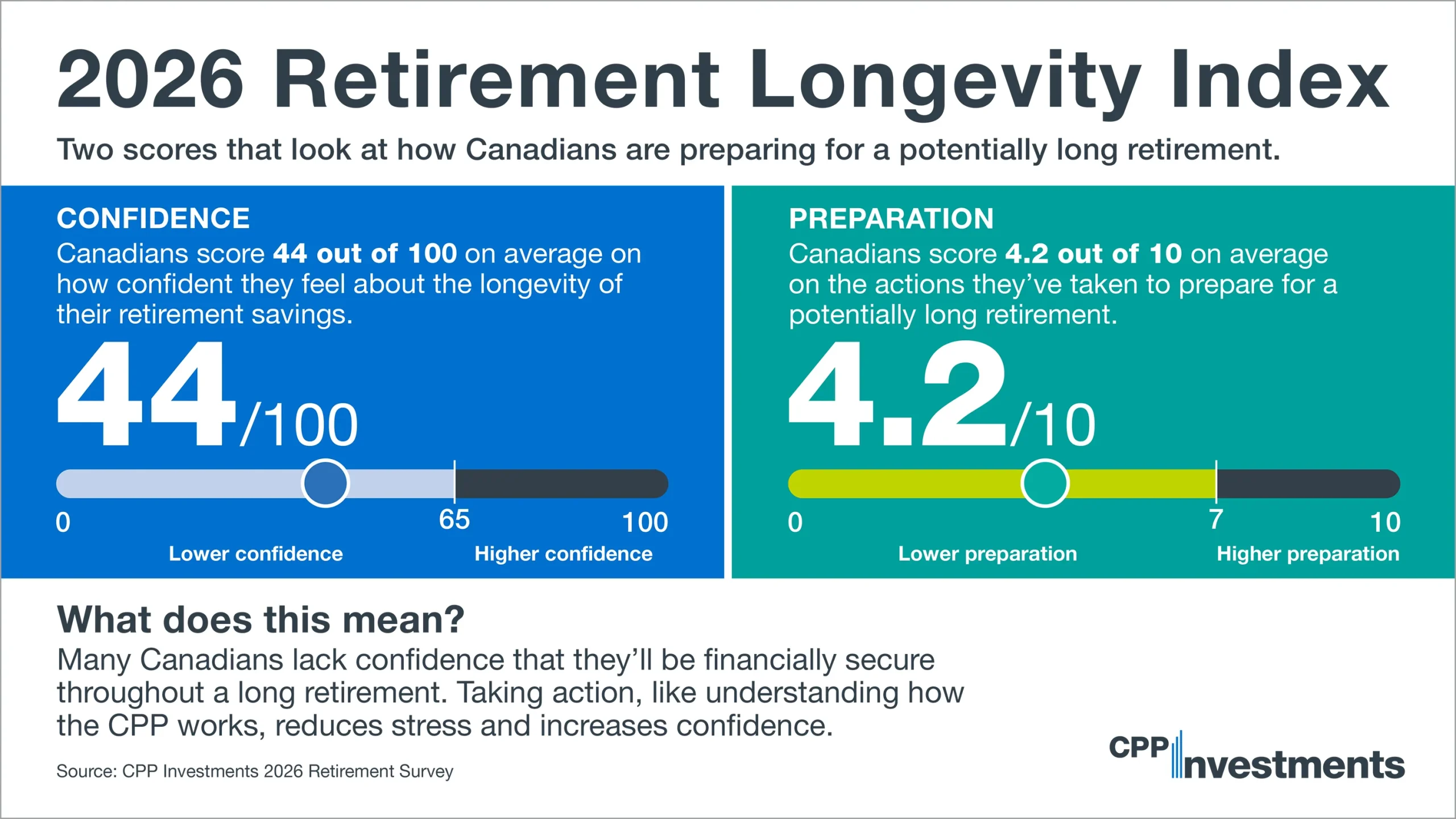
The 2026 CPP Investments Retirement Survey, released for Financial Literacy Month in November, introduces the Retirement Longevity Index, which measures how confident Canadians feel about financially supporting themselves throughout retirement and the actions they’re taking to prepare.
The Confidence Score measures how confident and secure Canadians feel about financially supporting themselves throughout a potentially long retirement. The average score was 44 out of 100, suggesting there’s room to build confidence.
The Preparation Score measures the actions people have taken to prepare for a potentially long retirement. The average score was 4.2 out of 10, suggesting many have more planning to do.
“Living longer changes the way we need to think about retirement,” said Michel Leduc, Senior Managing Director & Chief Public Affairs Officer at CPP Investments.
“Putting money aside is an important start, but planning also means thinking about how long retirement could last, the sources of income you may have and how those pieces fit together. With the CPP as a dependable foundation, supported by CPP Investments’ role in investing the CPP Fund, Canadians can feel better equipped to plan for a potentially long retirement.”
Preparing for a longer retirement
The CPP has supported millions in retirement since its inception in 1966, when average life expectancy in Canada was around 72 years. Today, life expectancy is about 82 years, and more than 12,500 Canadians are 100 or older, according to Statistics Canada.
Only about one in four survey respondents (26%) believe their retirement savings would last if they lived to 100. Fear of running out of money in retirement is highest among those under 65 (61%) and is more common among women (61%) than men (51%).
That’s where the CPP can help. Benefits are paid for life and adjusted annually for inflation to keep pace with the cost of living, regardless of how long retirement lasts.
Many Canadians have already taken an important first step: 75% have set aside money for retirement, and 76% recognize that people are living longer. Yet awareness isn’t always reflected in planning. Only 42% have a financial plan, and just 34% have one that considers how long their retirement could last.
The good news is that preparation is linked to greater confidence. The survey found that those with very low Preparation Scores averaged 35 out of 100 on confidence, compared with 58 among those with higher Preparation Scores.
Confidence rises with CPP knowledge
More than 22 million Canadians already have a head start on retirement planning through the CPP. Benefits are designed to replace up to one-third of average work earnings.
The CPP is one piece of the retirement income puzzle, alongside workplace pensions, personal savings, investments and other sources of income. Understanding what each provides can help with planning for the years ahead.
Among those who describe themselves as very familiar with the CPP, 77% are confident they have or will have enough savings to last throughout retirement, compared with 22% of those who aren’t familiar with the CPP or are unsure.
“The CPP is an important pillar of retirement income for Canadians,” Leduc continued. “Understanding what the CPP provides can help Canadians plan with greater confidence for a retirement that could last decades.”
A pension Canadians can count on
The Office of the Chief Actuary’s most recent review concluded that the CPP is projected to be financially sustainable for at least the next 75 years. CPP Investments supports that long-term strength by investing the funds not currently needed to pay benefits, helping grow the CPP Fund for generations of Canadians.
The CPP Fund had $863.6 billion in assets as at June 30, 2026, including $609.3 billion in cumulative net income generated from investment activity by CPP Investments since 1999. The CPP Fund is projected to reach $1 trillion by around 2030.
The CPP is also a source of pride. More than three-quarters (77%) of Canadians say they’re proud that Canada has a national pension plan like the CPP, up six percentage points from last year.
Survey methodology: The online survey was conducted by Innovative Research Group from August 27 to September 8, 2026, with an unweighted sample of 5,141 Canadians (outside of Quebec), 18 years or older, drawn from high-quality online panels. The sample is weighted to a final sample size of 4,000 to reflect the Canadian population based on Census data. While this is a representative sample, margins of error do not apply to most online surveys.
Let me hone in on what Michel Leduc, Senior Managing Director & Chief Public Affairs Officer at CPP Investments, said above:
“Living longer changes the way we need to think about retirement. Putting money aside is an important start, but planning also means thinking about how long retirement could last, the sources of income you may have and how those pieces fit together. With the CPP as a dependable foundation, supported by CPP Investments’ role in investing the CPP Fund, Canadians can feel better equipped to plan for a potentially long retirement.”
There are basically two risks for people without a DB pension or even a workplace pension and a third one we need to think of:
Not saving enough
Outliving your savings
and retiring during a nasty bear market
Those who know the value of a good pension understand that a well-managed DB pension pools investment and longevity risk, so no member ever retires without a monthly benefit.
This gives members peace of mind so they can plan better for retirement and enjoy it without always stressing about money.
And chances are many of the younger generation reading this will live past 100 (hopefully in good health), so it really becomes important to understand CPP, Old Age Security, and Guaranteed Income Supplement if needed.
Most people have no clue, none, how to properly prepare for retirement, never mind how to properly construct a portfolio that gets them there.
It's sad but that's the reality. And to be truthful, while I am all for financial literacy, people need to also think critically and manage their risk properly.
To be truthful, even the best funds have trouble managing insane volatility, so why do we expect Canadians to manage their own portfolio properly over the long run (some can, a lot of them can't and need a financial adviser and even that's not a perfect solution).
Anyways, let me wrap it up there, I can go on and on about this topic.
Below, how prepared are Canadians for a potentially longer retirement? The 2026 CPP Investments Retirement Survey explores how Canadians are planning and preparing financially for a potentially longer retirement.
The survey found that while 76% of Canadians say they’re familiar with the idea that people today are living significantly longer than previous generations, only about one-third have a retirement plan that considers how many years they may actually need to prepare for. The results also show that Canadians who take more steps to prepare for retirement, including understanding their sources of retirement income, such as the Canada Pension Plan (CPP), tend to feel more confident and less stressed about their financial future.
Listen to Jeffrey Hodgson, Managing Director, Global Stakeholder Affairs (previously at BlackRock) explain the findings. I also embedded the French version.
Third, Ontario's patient ombudsman reports more than 5,200 new complaints in 2025-2026, a 7% increase from the previous year. Resolved complaints rose 5% to just over 5,100, with communication consistently among the top five issues.
Lastly, people living in parts of northern Ontario say they’re being denied access to critical medical care — sometimes with deadly consequences. For The National, CBC’s Nick Purdon takes a closer look at what happens when the health-care system fails to be truly universal.
Sadly, while Ontario has a great pension plan for most healthcare workers (HOOPP), a lot of patients are falling through the cracks. It's even worse here in Quebec, and we need to be honest about the problems plaguing our national healthcare system (it's more like disaster care).

Comments
Post a Comment